

The Personalization Paradox
Every B2B marketer is chasing the same goal: make every buyer feel like the message was written specifically for them. The technology to do it has never been more accessible. AI-powered personalization engines, intent data platforms, predictive scoring models — the stack exists. The budget has been approved. The campaign is live.
And yet, your open rates are flat. Your reply rates are declining. Your sales team is hearing the same thing on calls: "We get so much generic outreach."
The problem isn't your messaging. It isn't your channel mix. It isn't even your AI model. It's the data you fed into it.
In B2B, the buying committee is complex — multiple stakeholders, multiple roles, multiple timelines. If your underlying contact and account data is dirty, your AI isn't personalizing anything. It's guessing. And buyers can feel the difference between a message crafted for them and a message that just has their first name in the subject line.
The 3 B2B Data Killers
Most B2B data quality problems fall into three categories. Each one is damaging on its own. Together, they make meaningful personalization structurally impossible.
1. Duplicates: The Brand Credibility Killer
Imagine receiving the same "exclusive, limited-time offer" three times in the same week — from the same company, to the same email address. Now imagine you're a VP of Marketing evaluating that vendor for a six-figure contract.
That's what duplicate records do to your brand. They don't just waste send credits. They signal to your most important prospects that your organisation doesn't have its house in order. If you can't manage your own contact database, how will you manage their marketing operations?
Industry benchmarks from Salesforce and Gartner consistently show that 10–30% of enterprise CRM records are duplicates. In databases that have grown through acquisitions, list imports, or years of manual entry, that number can climb higher. Every duplicate is a potential brand embarrassment waiting to happen — and in B2B, where deal cycles are long and relationships matter, a single awkward touchpoint can set a deal back months.
Deduplication isn't a one-time project. It's an ongoing discipline. Merge logic, golden record rules, and real-time duplicate detection at point of entry are the minimum viable standard for any organisation running AI-assisted outreach.
2. Missing Fields: The "Spray and Pray" Default
Personalisation at scale requires signals. Industry. Company size. Revenue band. Technology stack. Buying stage. Without these fields populated, your AI model has nothing to work with — so it defaults to the lowest common denominator: a generic message that could apply to anyone, and therefore resonates with no one.
This is the hidden cost of incomplete data that rarely shows up in a dashboard. Your AI isn't broken. It's doing exactly what it was designed to do — it's just working with half-empty inputs and producing half-baked outputs.
Consider what a missing "industry" field actually means in practice. Your AI can't segment a healthcare CFO from a retail CMO. It can't tailor the value proposition, the case study reference, the regulatory context, or the ROI framing. It sends the same message to both. Neither feels understood. Neither responds.
The fix isn't always enrichment. Sometimes it's better intake hygiene — mandatory fields at form submission, progressive profiling across the buyer journey, and a clear data ownership model that assigns accountability for field completion to specific teams and systems.
3. Data Decay: The Silent Rot
B2B data doesn't stay fresh. People change jobs. Companies get acquired. Titles shift. Email addresses change. According to research from Dun & Bradstreet and multiple CRM platform studies, B2B contact data decays at approximately 2.1% per month.
That sounds manageable. Run the maths over 12 months and it isn't. If you haven't run a systematic data refresh in a year, roughly 25% of your contact database is likely inaccurate or unreachable. In a 100,000-contact database, that's 25,000 records generating bounces, suppression list entries, and wasted AI compute — while your deliverability scores quietly deteriorate in the background.
The compounding effect is what makes decay so dangerous. A contact who changed jobs 18 months ago isn't just one bad record. They're a bad record that has been included in 40+ campaign sends, scored by your AI model hundreds of times, and potentially flagged as a spam trap by their old employer's mail server. The downstream damage from a single decayed record multiplies across every system that touched it.
Why This Breaks CLV-Based Selling
The Ideal Customer Profile is the foundation of modern B2B go-to-market strategy. Your CLV defines who you're selling to, what problems they have, and why your solution fits. ABM campaigns, AI scoring models, and sales territory design all flow from it.
But an CLV is only as good as the data it's built on. If your contact database is riddled with duplicates, missing fields, and decayed records, your CLV analysis is drawing conclusions from a corrupted sample. You're not identifying your best customers — you're identifying the best-represented contacts in a dirty database.
This creates a feedback loop that's hard to break. Bad data produces a flawed CLV. The flawed CLV drives targeting decisions. Poor targeting produces weak pipeline. Weak pipeline gets blamed on messaging or channel strategy. The data problem never gets addressed. The cycle repeats.
The organisations that break this cycle share a common characteristic: they treat data quality as a revenue operations priority, not an IT housekeeping task. They assign ownership, set measurable standards, and build data health into their quarterly business reviews alongside pipeline metrics.
The Buying Committee Complexity Problem
B2B deals don't close with one person. Gartner research shows the average B2B buying committee involves 6–10 stakeholders, each with different priorities, different information needs, and different roles in the decision process. Reaching all of them with relevant, coordinated messaging is one of the hardest problems in enterprise marketing.
Dirty data makes it exponentially harder. If your CRM has three duplicate records for the same person at the same account — each with slightly different job titles, different email addresses, and different engagement histories — your AI model sees three separate buyers instead of one. Your account-level scoring is wrong. Your multi-threading strategy is broken. Your sales rep walks into a discovery call with an incomplete picture of who they're actually talking to.
Clean, unified account data isn't a nice-to-have for buying committee orchestration. It's a prerequisite. Without it, your ABM programme is running on assumptions, and your AI is amplifying those assumptions at scale.
Fixing the Data, Fixing the Relationship
The good news is that B2B data quality problems are solvable. They require investment, discipline, and the right tooling — but the ROI is measurable and typically fast.
A structured data remediation programme typically addresses four layers:
- Deduplication: Establish golden record rules, run a one-time merge sprint, and implement real-time duplicate detection at all data entry points (forms, CRM integrations, list imports).
- Enrichment: Use third-party data providers (ZoomInfo, Clearbit, Cognism, Apollo) to backfill missing fields — industry, company size, revenue, technology stack, direct dial. Prioritise your highest-value segments first.
- Decay Management: Implement a rolling re-engagement and suppression programme. Contacts with no engagement in 12+ months should be re-permission'd or suppressed. Set a quarterly data refresh cadence for your top accounts.
- Governance: Define data ownership. Assign field-level accountability. Build data quality metrics into your RevOps dashboard. Make it visible, make it owned, make it measured.
When you fix the data, you fix the relationship. Your AI stops guessing and starts personalising. Your buying committee outreach becomes coordinated instead of chaotic. Your CLV reflects reality instead of noise. And your "personalised" outreach finally feels personal — because it is.
Where B³ Consulting Starts
Our Data Readiness practice begins every engagement with a B2B Database Health Audit — a structured assessment that quantifies your duplicate rate, field completion score, decay exposure, and CLV data coverage across your target segments.
Most clients identify their top three data quality gaps within the first two weeks. Remediation sprints typically deliver measurable improvements in email deliverability, AI scoring accuracy, and sales rep productivity within 60–90 days.
Start with a free AI Readiness Audit or speak with our advisory team about a B2B Data Health Assessment.
B³ Consulting Editorial Team
MarTech, AI Advisory & GTM specialists helping enterprise and mid-market companies get measurable ROI from their technology investments.
Related Articles
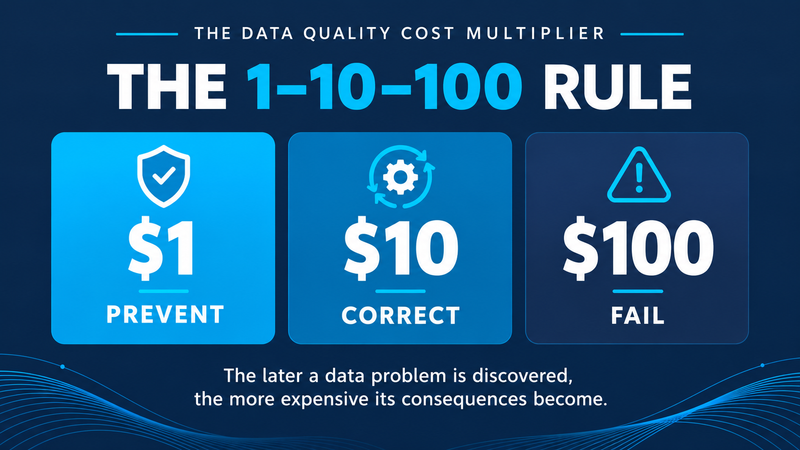
The 1-10-100 Rule: Why Waiting to Clean Your Data Is a 100x Mistake
Prevention costs $1. Correction costs $10. Failure costs $100.
Read Article
Garbage In, Garbage Out: AI Won't Fix Your Dirty Data
AI doesn't neutralise bad data — it amplifies it at machine scale.
Read Article
AI Data Readiness for Adobe Marketo Engage
Database architecture, deduplication, and smart data modelling for Marketo.
Read Article