

The Myth of "We Might Need It Eventually"
Every marketing ops team has said it. Every CRM admin has heard it. "Let's just keep that contact — we might need it eventually." It feels like the safe, conservative choice. Storage is cheap, right?
Wrong. Storing dirty data isn't a neutral decision. It's an active, compounding tax on every system, team, and budget line that touches your CRM. And unlike a tax you can see on a balance sheet, this one hides inside your platform invoices, your AI compute bills, and your sales team's calendar.
The question isn't whether you can afford to clean your data. It's whether you can afford not to.
What "Dead Souls" Are Actually Costing You
The term "dead souls" comes from Nikolai Gogol's 19th-century novel — a story about a man who purchases records of deceased serfs to game a census system. The parallel to modern CRM management is uncomfortably accurate. Thousands of contacts in your database have "moved on" — changed companies, changed roles, changed email addresses — but they still occupy rows in your system, inflate your contact counts, and drive up your platform costs.
Here's where the money actually goes.
1. CRM Tier Bloat: Paying Premium Prices for Dead Weight
HubSpot, Salesforce, and Marketo all price by contact volume or record count. HubSpot's Marketing Hub jumps from $800/month to $3,600/month as you cross contact thresholds. Salesforce charges per user but scales storage and API call limits by edition. Marketo's pricing is directly tied to your database size.
If 30% of your 100,000-contact database is outdated, duplicated, or unengageable — a conservative estimate for most enterprise CRMs — you are paying for 30,000 records that will never generate a single dollar of pipeline. At HubSpot's mid-market rates, that's potentially $800–$12,000 per month in pure waste, every month, indefinitely.
That's not a storage cost. That's a subscription to failure.
2. Wasted AI Compute: Paying AWS and Azure to Process Garbage
Every time your AI scoring model runs, your predictive analytics engine fires, or your marketing automation platform executes a segmentation query, it processes every record in scope — including the dead ones.
In cloud environments, compute isn't free. AWS SageMaker, Azure Machine Learning, and Google Vertex AI all charge by the hour or by the inference. When your model runs a nightly propensity score update across 100,000 contacts and 30,000 of them are junk, you're burning roughly 30% of your AI compute budget on records that will never convert.
At enterprise scale — where monthly AI compute bills can run $15,000–$50,000 — that's $4,500 to $15,000 per month in avoidable spend. Not because your models are inefficient. Because your data is.
3. The Friction Tax: Your Sales Team Is Your Most Expensive Data Cleaning Tool
This is the cost that never shows up in a software invoice, which is exactly why it's so easy to ignore.
Research from Salesforce and Forrester consistently shows that sales reps spend 20–30% of their working day on non-selling activities — and a significant portion of that is manual data hygiene: updating records, merging duplicates, correcting job titles, flagging bounced contacts, and chasing down account ownership conflicts.
Do the math on your own team. A sales rep earning $100,000 in base salary costs your business approximately $130,000–$150,000 fully loaded (benefits, tools, management overhead). If 20% of their time is spent fixing data instead of closing deals, that's $26,000–$30,000 per rep per year in productivity loss — not from underperformance, but from a data problem that was entirely preventable.
For a team of 10 reps, that's a quarter of a million dollars annually. Quietly. Invisibly. Every year.
The Compounding Effect: Why Bad Data Gets More Expensive Over Time
Here's what makes dirty data uniquely dangerous compared to other operational inefficiencies: it compounds.
A bad record today is one bad record. A bad record in 18 months is a bad record that has been processed by your AI model 547 times, included in 23 segmentation queries, triggered 4 automated nurture sequences, and been manually reviewed by 3 different sales reps. The original cost of that one bad record has multiplied across every system that touched it.
This is why the 1-10-100 Rule — $1 to verify at entry, $10 to clean after the fact, $100 to absorb downstream — understates the problem for AI-driven organisations. When AI systems process data at scale and at speed, the downstream cost of a bad record isn't $100. It's $100 multiplied by every automated decision that record influenced.
The CRM Graveyard Audit: Four Questions to Ask This Week
You don't need a six-month data governance project to start recovering value. Start with these four diagnostic questions:
- What percentage of your contacts haven't engaged in 18+ months? Any contact with zero email opens, zero web visits, and zero CRM activity in 18 months is almost certainly dead weight. Segment them, suppress them, and stop paying to store and process them.
- What is your duplicate rate? Industry benchmarks suggest 10–30% of enterprise CRM records are duplicates. Run a deduplication audit. The number will surprise you.
- How many contacts have no job title, no company, or no valid email? These records are structurally unusable for AI scoring, personalisation, or outreach. They are pure cost with zero upside.
- What tier are you on — and what tier would you be on with a clean database? Pull your contact count, subtract your estimated dirty records, and check your platform's pricing page. The savings are often immediate and significant.
Clean It or Delete It: The Only Two Acceptable Answers
There is a third option that most organisations choose by default: do nothing. Keep the records, keep paying, keep processing, keep losing sales productivity. It feels like the path of least resistance. It is actually the most expensive path available.
The right answer depends on the record. For contacts with enrichable data — a valid company, a guessable title, a recoverable email — invest in enrichment. ZoomInfo, Clearbit, and Cognism can recover significant value from incomplete records at a fraction of the cost of keeping bad data indefinitely.
For contacts that are genuinely unrecoverable — no valid email, no company match, no engagement in two or more years — delete them. Not archive them. Delete them. The psychological resistance to deletion is real, but it is not rational. A contact you cannot reach, cannot score, and cannot convert is not an asset. It is a liability with a monthly invoice attached.
Where B³ Consulting Starts
Our Data Readiness practice begins every CRM engagement with a Database Health Audit — a structured assessment that quantifies your dead record rate, duplicate rate, field completion score, and estimated platform cost savings from a targeted clean-up.
Most clients discover they can drop a full pricing tier within 90 days of a focused remediation sprint. The audit pays for itself before the first invoice arrives.
Stop paying for data that doesn't pay you back. Start with a free AI Readiness Audit or speak with our advisory team about a CRM Database Health Assessment.
B³ Consulting Editorial Team
MarTech, AI Advisory & GTM specialists helping enterprise and mid-market companies get measurable ROI from their technology investments.
Related Articles
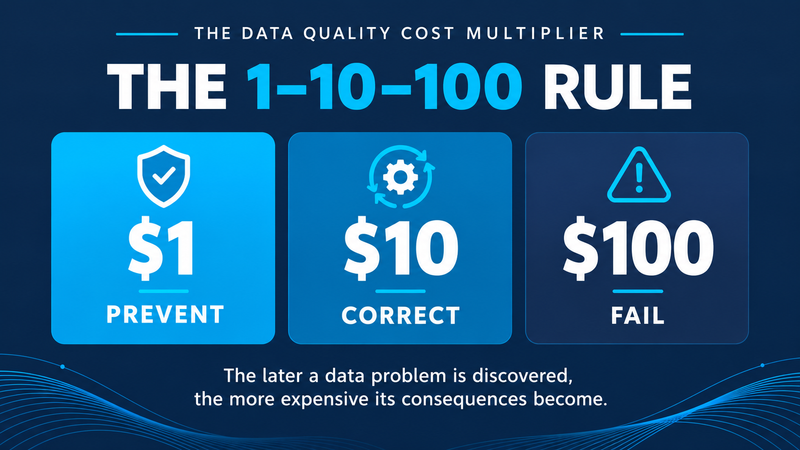
The 1-10-100 Rule: Why Waiting to Clean Your Data Is a 100x Mistake
Prevention costs $1. Correction costs $10. Failure costs $100.
Read Article
The B2B Blind Spot: Why Your "Personalized" Outreach Feels So Generic
Duplicates, missing fields, and data decay are silently destroying your CLV.
Read Article
Garbage In, Garbage Out: AI Won't Fix Your Dirty Data
AI doesn't neutralise bad data — it amplifies it at machine scale.
Read Article